
Introduction to Yield Farming

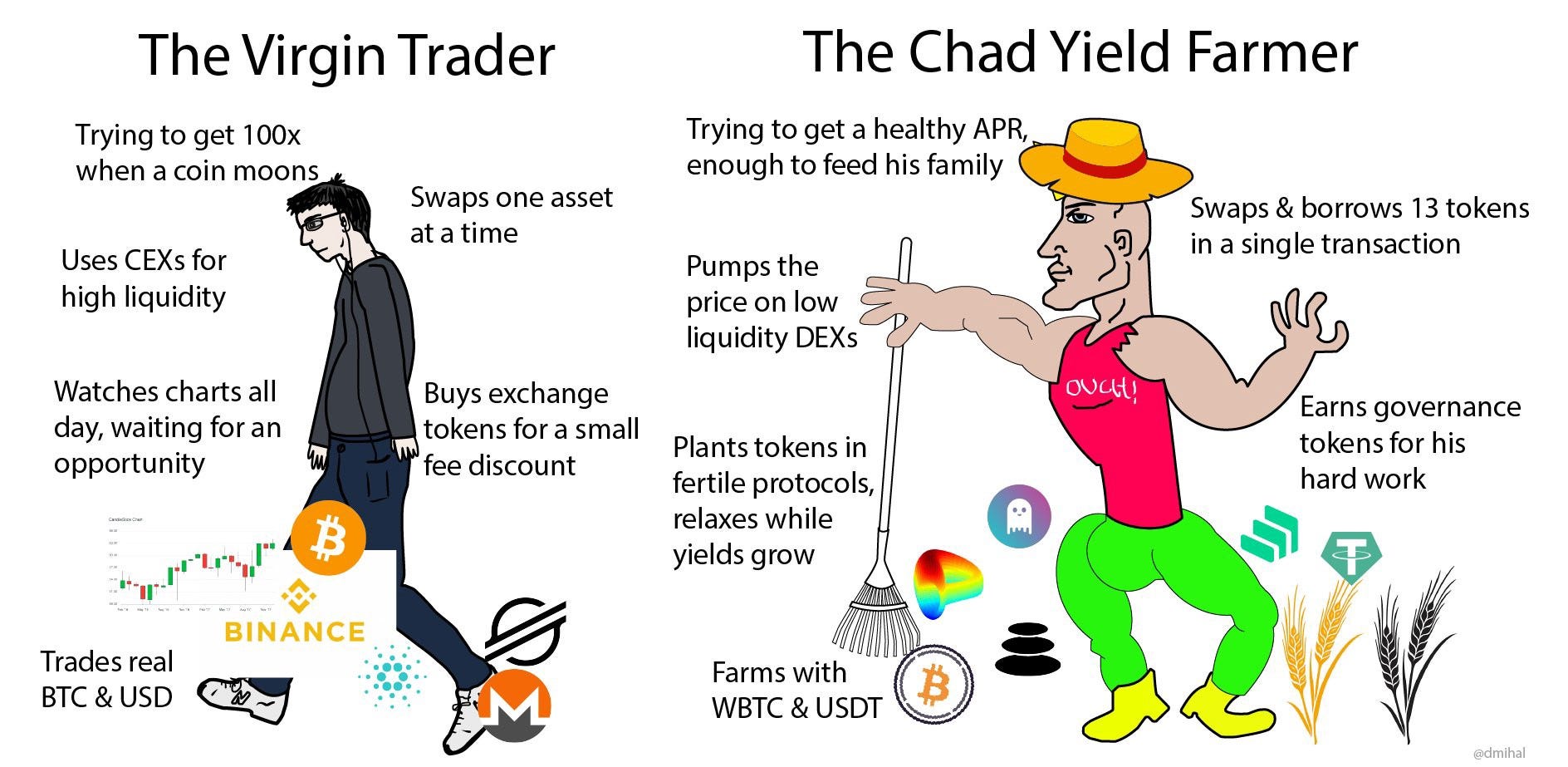
I’ve been dedicating almost all of my time into diving into DeFi in the past few weeks.
As of today, my new Crypto Portfolio is up 30%, over 2 weeks. Lol. Crypto world is crazy.
I want to briefly go over what I can, helping others alongside me and forming a diary for myself.
Simply put, DeFi farms rely on Liquidity to operate, so they pay investors to park their crypto assets with them. For example, if they want to maintain liquidity for trading between ETH & BTC, they will issue a ETH/BTC LP, and get you to invest 50% of each in a pair with them.
They can then trade it forward and backward. That’s basically it.
Project Native Token
Each project has their own token, and the utility (demand) and supply factors will determine its price. For Pancake, its Cake. For Autofarm, its Auto. It is important to understand the utility/demand of their token, both in the present and the future. Because this causes the price to go up. Cake performs well, with a large market capitalization, because it has a lot of utility. For example, their IFOs (getting IPO allocations) or Lottery. Find out more on their website.
Some tokens will come up with different ways of doing things, and you can analyse and bet on projects with features that you like. For example, I am bullish on Uranium Finance, because they give dividends to their tokenholders. A lot of projects do, and this give tokens cashflow. With cashflow, you can even calculate DCF models to preict prices etc, although I wouldn’t.
Yields are in Native Token
When AUTO or CAKE or BUNNY gives you high yields of 300-800% APY, a portion, if not all will be given in the native token.
So if you stake in Autofarm, you will receive a % of your yields in Auto. Same for Cake, same for Bunny.
Why is this important? Cause the price of the Token, determines your yield. The higher the price, the higher the yield (cause u can sell the token for more). So this goes back to the initial first point. Understand the native token, and look for projects that you are bullish on the token. Or regularly sell it to DCA out, giving you reduced exposure to the price.
Emissions/Inflation
Emissions: How many new coins are created per block mined.
This emission number, determines how much native tokens the liquidity providers/investors, get. The higher the emissions, the more tokens are minted and given to the investors, and creates more selling pressure. The higher the emissions, the higher the inflation (or reduction in value). Some tokens are highly inflationary and with high emissions, like BUNNY. This causes high selling pressure, making sure that the price doesnt go anywhere. Or so I thought, but BUNNY is going up.
So when your looking into projects, understand the emissions number. The higher the emissions, the more yields you get in tokens, but also causes prices to stagnant. Most projects have a “deflationary” point, but learn to analyse yourself to see if its really deflationary. Also, projects will say stuff like “Elastic Emissions” or “Reducing emissions” which is all valid, so analyse and make your decision. Also, remember that these are “Supply” factors, and not demand ones. If utility/demand is sky high, high emissions isnt a problem either (CAKE).
Size of Farm/TVL
There are big farms, and there are small farms. We can tell the size of the farm by its “TVL”, or Total Value Locked.
Large farms like Pancake Swap, Autofarm & Pancake Bunny, at 1bil+ in TVL. These farms have native tokens that have stabilised in price. These farms usually have utility for their tokens, and fleshed out tokenomics and are audited by reputable firms.
Smaller Farms like Neonic Finance, Deflate Finance & Uranium Finance have much less TVL, more volatile prices, and tokenomics thats not fully implemented or fleshed out yet. They also might not be audited, or audited by random small audit firms which opinions carry little weight. The risk of being in these farms is much much higher, but usually comes with higher APYs (cause emissions are still high) allowing you to easily accumulate a large token position (in no. of tokens and not price) with small capital. A common strategy here is to park non-native tokens in small farms to farm the native token, and keep dumping it. This gives you a high APY with low native token exposure.
That’s it for now, but expect more articles. Join HUM Crypto if your interested to keep learning! I’m no expert, but I’m doing my best 24/7 in crypto right now.